Quick answer
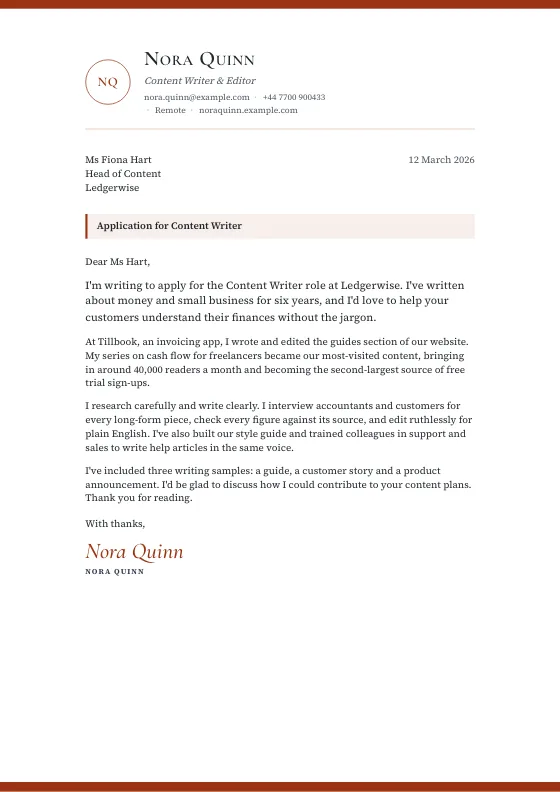
A professional cover letter is three or four short paragraphs on one page: why you're writing and for which role, the two or three things you've done that match what the employer needs, why this company in particular, and a brief, confident close. Address a named person when you can, mirror the job advert's language, and keep it under about 400 words.
Not every hiring manager reads cover letters, but the ones who do use them to answer questions a resume can't: why you want this job, how your experience connects to their problems, and whether you can write a clear, persuasive page. A generic letter wastes that chance. A specific one can be the reason you get the interview.
Here's a structure that works for most roles, with an example of each paragraph.
In this article
Before you write: find the three things that matter
Read the job advert and pick out the requirements that are repeated, listed first or described in detail. Those are usually what the team is struggling with. Then match each one to something you've actually done.
| They ask for… | Your evidence |
|---|---|
| “Manage multiple client accounts” | Looked after 14 retail accounts at once; renewed all but one last year |
| “Comfortable with data” | Built the monthly sales report in Excel that the regional team now uses |
| “Clear written communication” | Wrote the onboarding guide for new account managers |
Those three pairs become the middle of your letter.
The structure, paragraph by paragraph
- 1Opening (2–3 sentences). Name the role, and lead with your strongest relevant fact. “I'm applying for the Account Manager role at Brightline. For the past three years I've managed a portfolio of 14 retail clients at Northway, keeping renewals high while growing average order value.”
- 2Evidence (1–2 paragraphs). Take two or three of your matches and give each a sentence of context and a result. Use numbers you can stand behind.
- 3Why them (2–3 sentences). Show you know what the company does and why it appeals to you — a product, a client, a value, a recent project. Keep it specific and genuine.
- 4Close (1–2 sentences). Say you'd welcome a conversation, and thank them. No need to repeat your contact details if they're in the header.
Who to address it to
Use a name when you can find one — the hiring manager named in the advert, the team lead on the company's site or LinkedIn. “Dear Ms Rahman” or “Dear Sam Rahman” both work. If you can't find a name, “Dear Hiring Manager” or “Dear [Team name] team” is fine.
Avoid “To whom it may concern” and “Dear Sir/Madam”: they feel dated and impersonal.
Tone and length
- Length: roughly 250–400 words. If it spills onto a second page, it's too long.
- Voice: professional but natural — write as you'd speak in a good interview. Short sentences help.
- Focus: more “you” than “I”. Frame your experience around what it would do for them.
- Don't repeat the resume. Pick the most relevant points and add the context a bullet can't hold.

Tailoring each letter without starting from scratch
Keep a base letter with your best evidence paragraphs, then change three things for every application: the opening (role and company), the evidence you pick (to match that advert's priorities) and the “why them” paragraph. That's ten or fifteen minutes per letter, and it reads as if it were written for them — because the important parts were.
Try the free Cover Letter GeneratorStart from your resume and the job description, choose an approach, then edit each paragraph and run the quality check.Final checklist before you send
- The company name and role are correct everywhere (a classic copy-and-paste mistake).
- Every claim matches your resume, and every number is one you could explain.
- It fits on one page, with the same fonts and header as your resume.
- It's saved as a PDF named “Firstname-Lastname-Cover-Letter.pdf”, unless they asked for text in a form.
- You've read it aloud once — it's the fastest way to catch clumsy sentences.
Pair it with a resume that tells the same story: see which resume format to use and the mistakes to avoid.
Frequently asked questions
How long should a cover letter be?
About 250–400 words in three or four paragraphs, and never more than one page. Hiring managers skim, so lead with your strongest, most relevant point.
Do I still need a cover letter?
Send one when the application allows it, and always when it's requested. Not every recruiter reads them, but a specific, well-written letter can set you apart from similar resumes.
What if I can't find the hiring manager's name?
Use “Dear Hiring Manager” or address the team, such as “Dear Marketing team”. Avoid “To whom it may concern”.
Can I use the same cover letter for every job?
Keep a base letter, but change the opening, the evidence you choose and the paragraph about why you want that company for every application.